
Agro-Industrialization, Export Systems & Market Access.
A professional certificate that links local food processing to the systems that move products to market: packaging and quality, customs and transit, transport and logistics. Being developed by Nayokan Association with Gloway.
○ In development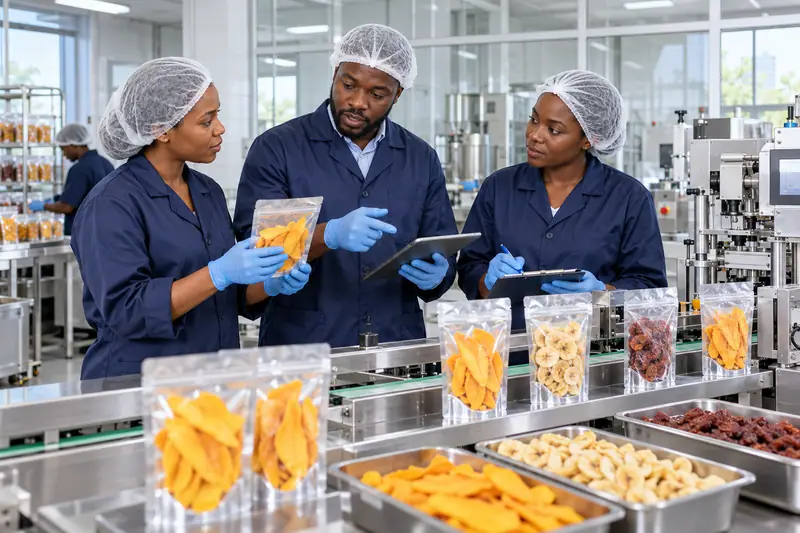
Overview
Transform locally. Move efficiently. Trade competitively.
Processing without a market is not industrialization. This professional certificate prepares food processors, trade operators and small businesses to transform products locally, move them efficiently and trade competitively, by connecting food processing to the standards, logistics and buyer requirements that decide whether a product reaches a market.
It is being developed by Nayokan Association with Gloway, Nayokan's principal partner for agrobusiness and agro-food. It sits within the policy context of Cameroon's SND30, import substitution and agro-industrialization.
Why it matters
Cameroon needs more than local transformation. It needs transformed products that can move through standards, logistics and buyers. A processor can transform well and still fail if the product is not packaged, compliant, costed, documented and connected to buyers.
The programme starts from market requirements and works backwards. Production is built for a market from the beginning, instead of searching for a buyer after the stock is made.
Who it is for
Food processors, trade operators and small and medium enterprises. Each module is tied to a job function, an enterprise need or a trade operation.
What participants learn
- Food processing: hygiene, preservation, standardization and value addition.
- Packaging and quality: food-grade packaging, labelling, traceability and product consistency.
- Customs and transit: trade documents, customs workflow and clearance coordination.
- Transport and logistics: warehousing, cold chain, inland transport, freight and containers.
Practical activities
Real Cameroonian foods become the classroom. Learners work with actual products, such as leafy vegetables like ndolé, beans and dry foods, specialty foods, and prepared or wrapped foods, so that training leads to better processing, packaging, costing and readiness. The aim is local value addition before products enter domestic or export distribution.
The programme is also designed to introduce learners to real export workflows: receiving, inspecting, consolidating, preparing and loading goods, and sourcing, compliance, costing and shipment visibility, through Gloway's systems.
From training to enterprise
The certificate is the start of a pathway from skills to market participation:
- Certify: complete a practical assessment.
- Incubate: strengthen the enterprise and the product.
- Qualify: meet supplier and product requirements.
- List: eligible profiles can be considered for the Gloway supplier network.
- Access: requests for quotation and supply opportunities.
Completing the training does not itself mean regulatory approval, supplier qualification or a guaranteed export contract. Opportunities depend on demand, quality, capacity and reliability.
Eligible trained processors can also be supported toward export compliance onboarding, including preparation for FDA facility registration where it applies to businesses targeting the U.S. market. This is preparation support, not an approval.
Programme details
This programme is in development with its partners. Duration, schedule, fees, entry requirements, assessment and the recognition of the certificate will be published once confirmed. Register your interest and the VTI team will be in touch.
Where this connects.
Training is the first step in Nayokan’s ecosystem, which continues through incubation, financing and enterprise growth.